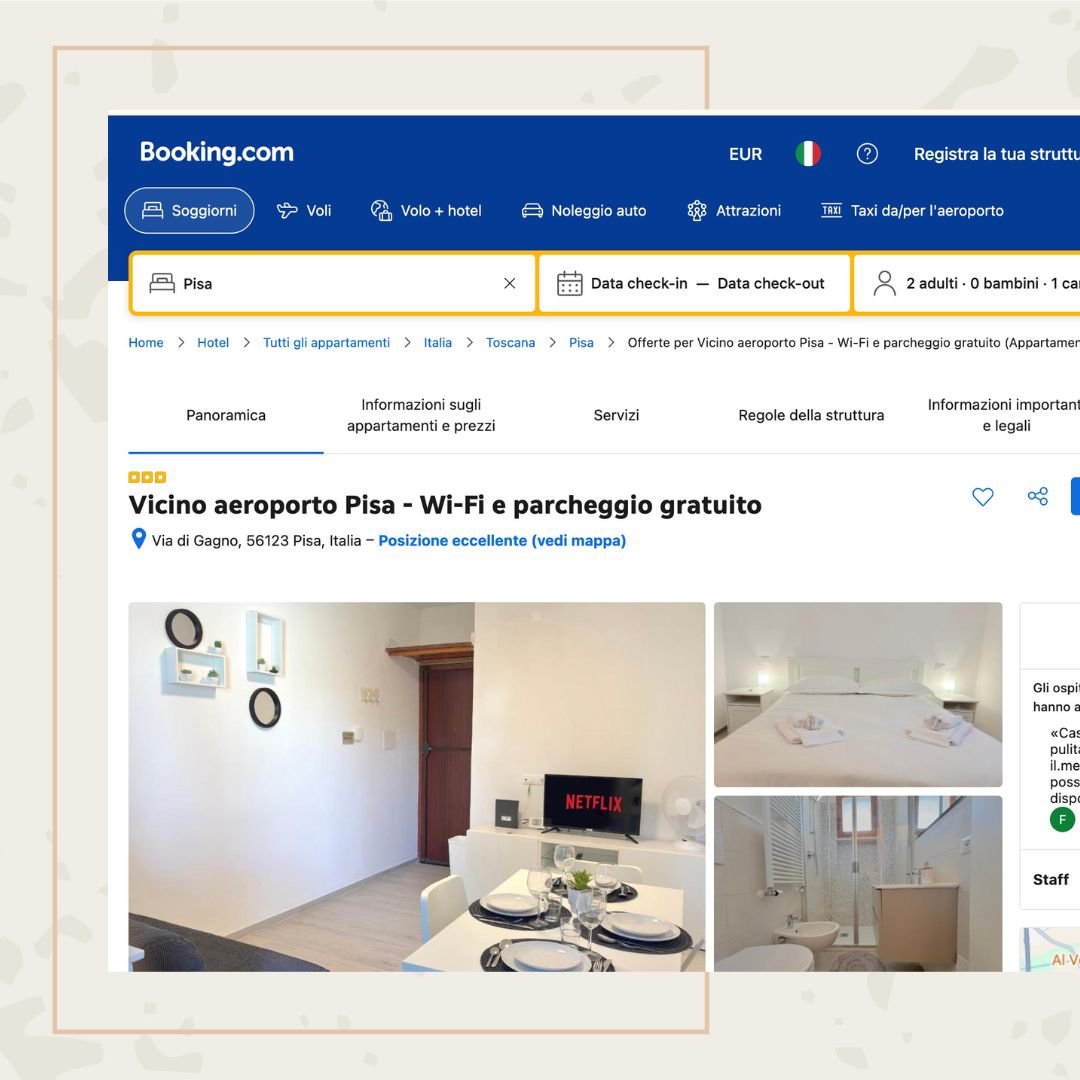
If you're considering a short-term rental in Tuscany, you've probably already come across titles like:
“50,000 euros a year”, “double-digit returns”, “better than traditional real estate”.
All true.
Or almost.
Because the point is not how much you earn, but How much is really left in your pocket at the end of the year?. And it's precisely at this point that many investors get hurt, often without realizing it.
The big misunderstanding about short-term rentals: gross is not profit.
An apartment in Florence can generate income without difficulty 30,000–50,000 euros gross per year. In some cases, even more. These numbers, on paper, make short-term rentals seem unbeatable compared to a traditional 4+4 lease.
The problem emerges immediately after, when items that many underestimate begin to disappear from the gross:
- platform commissions (Airbnb, Booking, etc.)
- operational management costs
- cleaning and maintenance
- tax obligations and taxation
At that point, the final result changes. And it changes a lot.
This is where it comes down to whether short-term rental is an investment or just a poorly paid job.
How Much Do Short-Term Rentals Really Yield in Tuscany?
To understand if they are really worth it, you have to look at the real average numbers, not the exceptional cases reported online.
Florence
- Average annual gross revenue: approximately €50,000
- Average rate: €209 per night
- Employment rate: 67% (about 246 nights)
The best properties, in strategic areas and with professional management, can exceed €70,000–78,000 gross per year.
Those managed without a strategy often end up paying much less. Same city, same market, opposite results.
Lucca
- Average annual revenue: approximately €41,800
- Average rate: €199 per night
- Average occupancy: 60%
Here too the top performers surpass €55,000–57,000 gross, but only when every aspect is set correctly.
Key message: the city matters, but management matters more.
From gross to net: the data that really matters
Once subtracted:
- platform fees (15–20%)
- operating costs
- taxation
the picture is getting smaller, but it remains very interesting if management is optimized.
- Florence: average annual net between €9,000 and €12,000
- Lucca and similar tourist cities: €8,000–10,000
- National average: €5,000–6,000
In Tuscany, with carefully selected properties and structured management, Short-term rentals maintain a clear advantage over traditional leases.
Uncomfortable but honest conclusion:
A short-term rental managed without a strategy is as profitable as a 4+4.
A well-managed short-term rental clearly outperforms the 4+4.
Short-term rentals vs. long-term rentals: a real-world comparison
A serious comparison does not look at the theoretical maximum, but at the real average.
I wait | Short-term rental | 4+4 contract |
|---|
Annual gross income | €30,000–50,000 | ~10.800 € |
|---|
Average net income | €9,000–12,000 | ~6.800 € |
|---|
Management | High | Minimum |
|---|
Regulatory risk | Medium-high | Bass |
|---|
Flexibility | High | Low |
|---|
Predictability | Average | High |
|---|
The point is not to establish which model is “best overall”, but which is best suited to the property and the investor.
A concrete example: an average apartment in Florence
Let's compare two realistic scenarios.
Short-term rental
- Annual gross revenue: 30.000 €
- Real net: €9,500–11,000
4+4 contract
- Annual gross revenue: 10.800 €
- Net: approximately €6,800
Different numbers.
Different commitment.
Different final result.
And this is where the right question arises, the one that few people actually ask themselves:
Does it make sense to take on a short-term rental?
The answer is simple: It depends on how you start.
Where you win (or lose) with short-term rentals
Short-term rentals work when:
- the property is chosen with a performance logic, not an emotional one
- Prices are dynamic and data-driven
- management is structured and continuous
- taxation is optimized from the start
When even just one of these elements is missing, the “big take” remains just a number on paper.
The role of Eweka
Eweka works right here: before problems arise.
We support Italian and foreign investors who want to generate revenue from properties in Tuscany, taking care of:
- investment analysis before purchasing
- choice of the most convenient area and rental model
- net yield optimization
- support on regulations, taxes and management
In other words, we transform theoretical numbers into concrete and sustainable results.
Conclusion
Short-term rentals can be very profitable.
But only if you stop looking at the gross and start thinking like an investor.
If you are evaluating a property or already own one and want to understand how much can it really make, not in theory but in your specific case, Eweka is the right starting point.
Better to do the math first.
Much better than finding out later.